How Getscreen.me Helped a Latin American Fintech Scale Secure Remote Operations
As digital banking and online payments became increasingly popular across Latin America, one rapidly growing fintech company found itself facing a new challenge. The business was expanding faster than its IT department could support.
Every new market meant more employees, more customer support agents, more operational systems, and more devices requiring administration. What once worked for a team of 5 technicians no longer scaled for a company operating across multiple countries.
The organization launched a project to standardize remote administration and create a secure way to support its distributed workforce.
Privacy
As we value our clients' privacy and due to the Non-Disclosure Agreement with the company, we cannot reveal the legal business name. Therefore, this use case is anonymous.
After implementing Getscreen.me, a team of 12 IT specialists gained centralized control over more than 450 devices and provided remote support to employees across five countries in Latin America.
About the Company
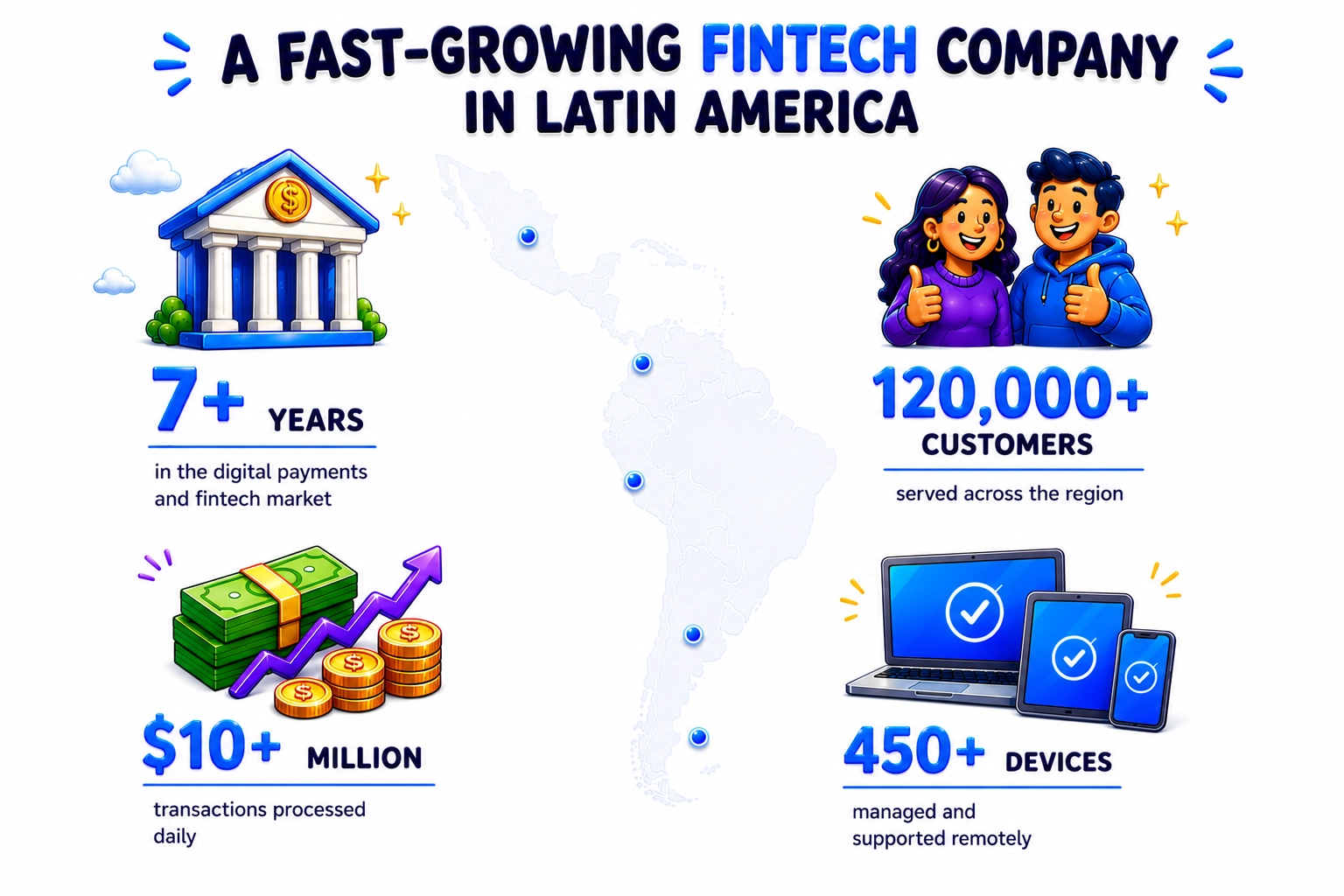
Founded in 2018, the company specializes in digital payments and merchant services for small businesses. It now serves more than 120,000 customers across Mexico, Colombia, Peru, Chile, and Argentina. The service processes more than $10 million in transactions daily.
Almost 70% of the business workforce is operating remotely. Teams operate 24/7. The smallest technical issue affects employees and has a direct impact on payment processing, fraud monitoring, customer support, and merchant onboarding.
Why It Matters
In fintech, a few minutes of downtime can delay transactions, disrupt customer service, and create significant financial and reputational risks.
Why the Company Chose Getscreen.me
The company initially relied on a combination of VPN access, remote desktop tools, and manual troubleshooting. As the business expanded, this approach became increasingly difficult to maintain.
The IT department began facing several problems:
- employees working from home could not always connect to corporate systems;
- supporting devices in different countries became time-consuming;
- onboarding new employees required complex manual configuration;
- support teams lacked visibility into remote devices;
- maintaining security standards across multiple tools became difficult.
The company needed a platform that would allow technicians to securely access remote devices from anywhere without creating additional complexity for employees.
Key Challenges the Business Faced
Supporting a 24/7 Payment Operation
Fraud monitoring teams, payment operations specialists, and customer support agents work around the clock. When an employee's workstation stops functioning or loses access to a business-critical application, every minute matters.
The IT team needs the ability to connect to any device immediately without requiring the employee to perform complicated setup procedures.
Rapid Employee Growth
The company was hiring aggressively and opening new operational hubs across Latin America.
Every month, dozens of new employees required:
- access to corporate applications;
- workstation setup;
- software installation;
- security configuration;
- technical support.
Sending equipment to regional offices was simple. Configuring and supporting it remotely was much harder.
High Security Requirements
As a financial services provider, the company had strict internal security policies. The IT department needed:
- encrypted connections;
- two-factor verification;
- controlled access to devices;
- session history;
- centralized administration.
Security was a crucial business requirement.
Lack of Local IT Teams
The company did not maintain dedicated IT personnel in every country. Only a small team of specialists in Mexico was responsible for supporting employees across the entire region.
Without reliable remote access, resolving even minor incidents often required lengthy troubleshooting calls and significantly increased response times.
Key Objective
The company needed a secure remote access platform that would allow a small IT team to support a rapidly growing international workforce from a single location.
Requirements for the New Platform
During the evaluation process, the team defined several key requirements:
- instant remote access to employee devices;
- browser-based connections;
- support for unattended access;
- multi-factor authentication;
- ease of deployment;
- centralized management;
- scalability;
- enterprise-grade security.
The company also wanted a solution that employees could start using immediately without lengthy training.
How Getscreen.me Helped
After implementing Getscreen.me, the client gained a centralized platform for managing more than 450 devices across five countries.
The IT department now uses Getscreen.me to:
- provide technical support to remote employees;
- configure newly delivered workstations;
- deploy software updates;
- troubleshoot payment applications;
- maintain devices used by customer support and operations teams;
- resolve incidents outside business hours.
Permanent Access became particularly valuable for supporting employees working in different time zones and for administering unattended devices.
The company also actively uses:
- two-factor authentication;
- file manager;
- remote invitations;
- session history;
- user groups and permissions;
- Wake-on-LAN.
As a result, most incidents can now be resolved remotely within minutes.
The IT department no longer depends on local administrators or lengthy troubleshooting calls. This allows teams to support continued growth without increasing the size of the support team.
Results
Getscreen.me helped the company build a secure and scalable remote support model that supports hundreds of employees and devices across Latin America.
The company significantly reduced the time required to resolve incidents, accelerated employee onboarding, and improved the availability of critical financial services.
Most importantly, the organization gained a centralized platform that allows a relatively small IT team to support a rapidly growing fintech business operating around the clock.